A clear guide to reboilers in distillation: what a reboiler does, kettle and thermosyphon types, forced circulation, TEMA classes, materials, sizing inputs and how to choose and order a reboiler in India.

A reboiler is a heat exchanger fitted at the bottom of a distillation column that boils part of the bottom liquid and returns the vapour to the column, supplying the heat needed for separation. The two main types are the kettle reboiler, with an oversized shell and internal weir, and the thermosyphon reboiler, which circulates fluid naturally.
A reboiler is a specialised heat exchanger that supplies heat to the bottom of a distillation column. Liquid from the column sump (or a draw-off from the bottom tray) flows to the reboiler, where it is heated until part of it vaporises. The vapour returns to the column and rises through the trays or packing, carrying the lighter components upward, while the unvaporised liquid leaves as bottoms product. Without a reboiler there would be no upward vapour flow, and a column could not separate anything.
Reboilers are therefore central to every distillation unit in refineries, petrochemical plants, chemical plants and solvent recovery systems. The reboiler duty is also the largest energy consumer in many separation units, so design quality has a direct effect on plant running cost.
Creative Engineering builds reboilers as part of its heat-exchanger range, to TEMA classes B, C and R and ASME Section VIII Div 1, for customers in India and abroad.
Related guides: how the column itself works is explained in what is a distillation column, and the generic exchanger theory is in what is a heat exchanger.
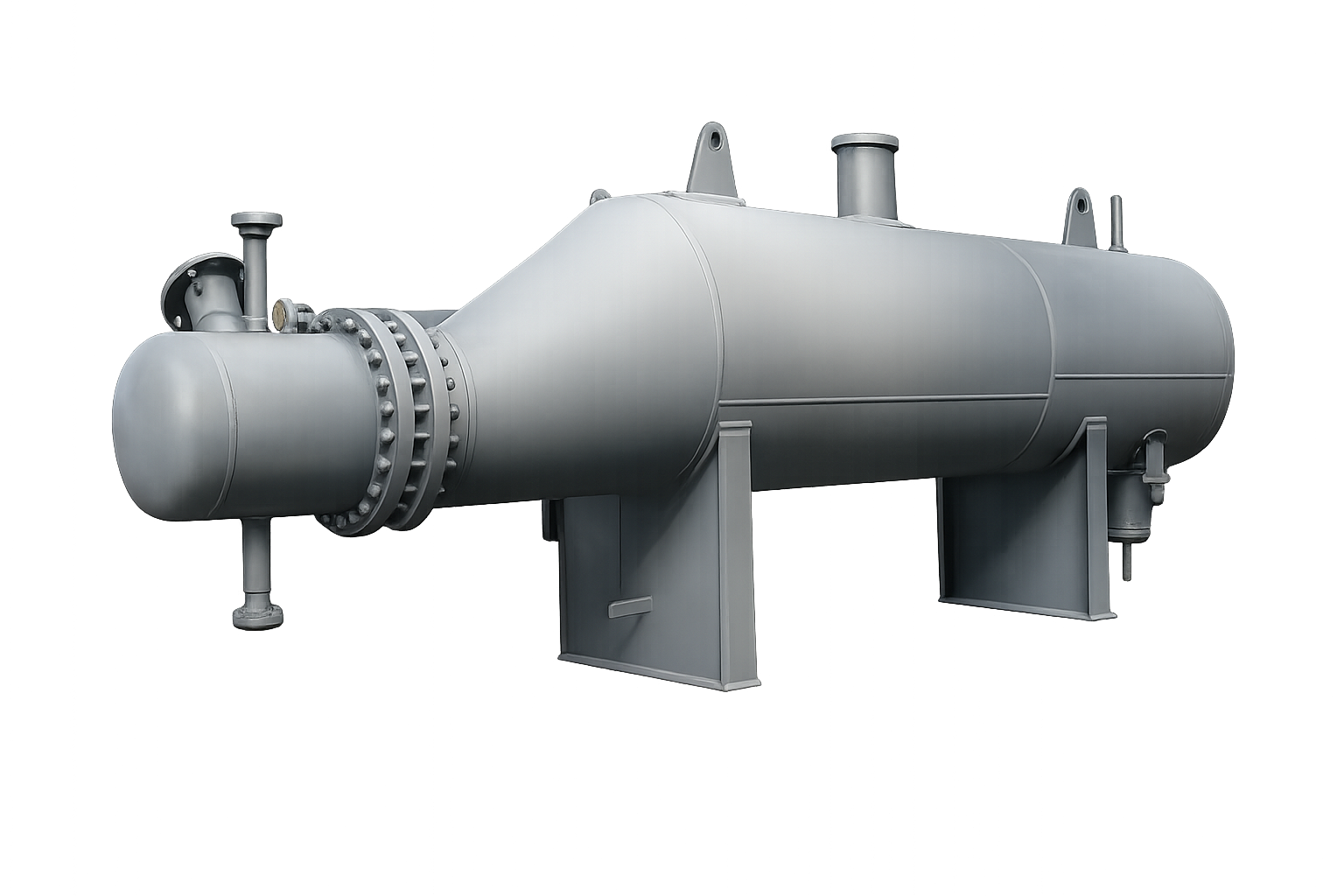
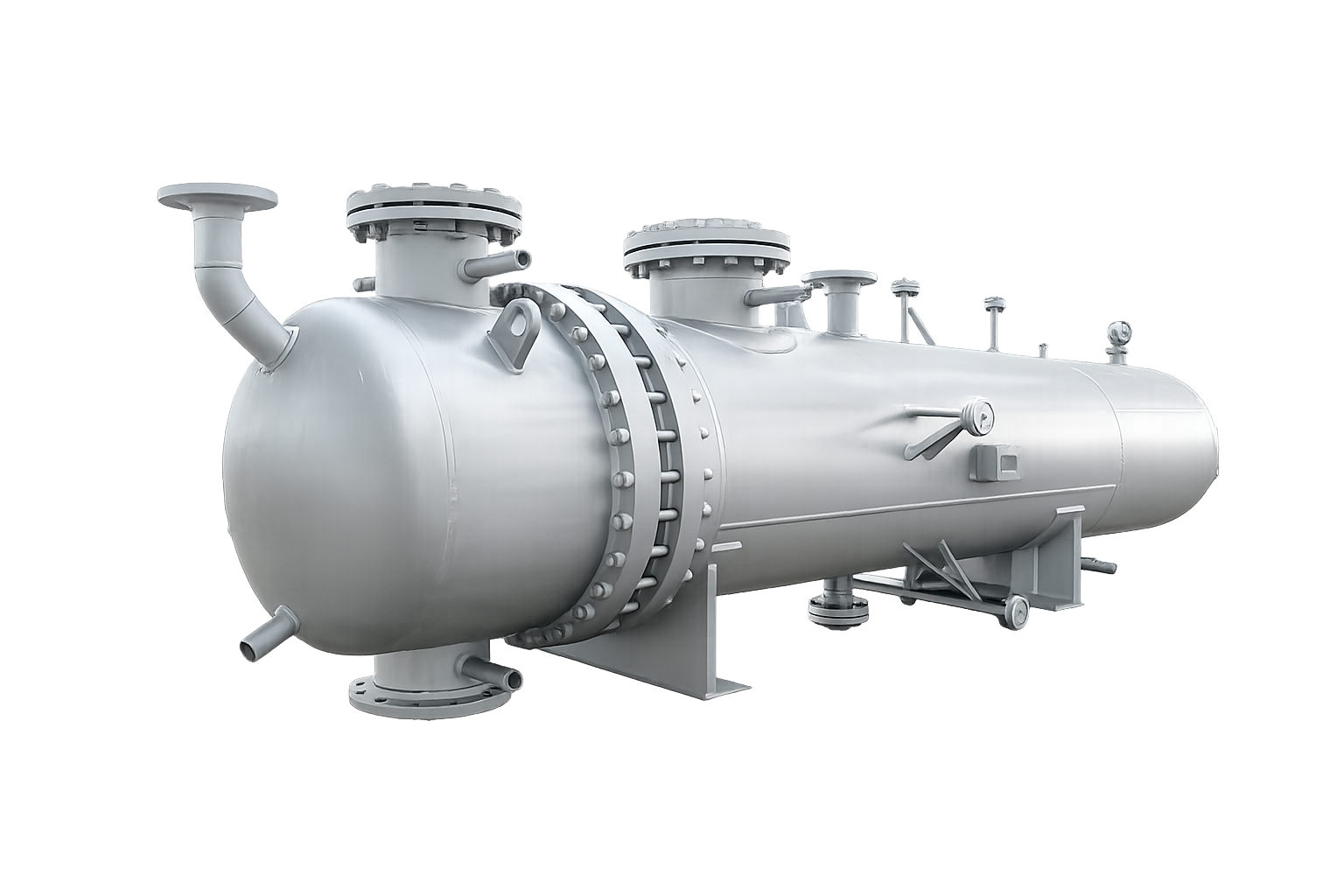
A kettle reboiler has an oversized shell, larger than the tube bundle, so that vapour can disengage from the boiling liquid. An internal weir keeps the tubes submerged and sets the liquid level, with the bottoms product overflowing the weir. The large shell gives a wide turndown range and handles fouling services well, which is why kettles are common in refineries and chemical plants.
A thermosyphon uses natural circulation: heating reduces the density of the fluid in the reboiler, and the difference in density between the column bottom and the exchanger drives flow without a pump. Thermosyphons are compact and lower cost than kettles. They can be vertical or horizontal, with the boiling either in the tubes or on the shell side.
A pump drives liquid through the exchanger at high velocity. This is used for viscous or heavily fouling liquids where natural circulation would be unreliable.
| Feature | Kettle | Thermosyphon | Forced circulation |
|---|---|---|---|
| Circulation | Pool boiling in shell | Natural, density driven | Pump driven |
| Footprint and cost | Larger, higher cost | Compact, lower cost | Pump adds cost |
| Fouling tolerance | Good | Moderate | Very good |
| Turndown | Wide | More limited | Wide |
| Best for | Refineries, fouling duties, wide turndown | General clean services | Viscous or high-fouling fluids |
Reboilers are designed to TEMA (classes B, C and R) and to ASME Section VIII Division 1, with welding to ASME Section IX. Typical material choices are carbon steel for non-corrosive hydrocarbon service, SS 304 or SS 316L for chemicals and pharma, and alloy steel, Duplex or Super Duplex for aggressive or high-temperature fluids. Custom nozzle orientation and flanged connections are available so the reboiler fits your column piping.
Boiling regime and heat flux. A boiling liquid transfers heat well up to a limit called the critical heat flux. Beyond that point a vapour film blankets the tubes and heat transfer drops sharply, which can overheat tube walls and foul the surface. Designers therefore keep the heat flux below the safe limit for the fluid and pressure, using more tubes or area if necessary.
Circulation ratio. In a thermosyphon, only part of the liquid flowing through the tubes turns to vapour. A moderate vapour fraction keeps tubes wet and reduces fouling, while a very high vapour fraction risks dry-out. The circulation depends on the piping resistance and the elevation, so line sizes between column and reboiler are part of the design, not an afterthought.
Temperature difference. Too large a temperature difference between the heating medium and the boiling liquid pushes the heat flux up and increases fouling; too small a difference makes the exchanger very large. For heat-sensitive products a lower-temperature medium is used even if it requires more surface.
Pressure drop and vacuum service. Many solvent recovery columns run under vacuum, where the boiling temperature is low and vapour volume is large. Reboiler nozzles and piping are generously sized in vacuum duty to avoid choking the flow.
| Design factor | If too high | If too low |
|---|---|---|
| Heat flux | Film boiling, tube overheating, fouling | Oversized, costly exchanger |
| Vapour fraction | Dry-out of tubes | Poor use of surface, high liquid flow |
| Temperature difference | Fouling and product degradation | Large area needed |
| Piping resistance | Reduced circulation | Free circulation, stable operation |
| Symptom | Likely cause | Remedy |
|---|---|---|
| Column bottom temperature falling | Reduced heat transfer due to fouling | Clean the exchanger; review fouling allowance |
| Unstable boil-up or pulsing | Circulation problem in thermosyphon | Check line sizes, liquid level and elevation |
| Low bottoms purity | Insufficient boil-up | Increase heating medium flow; check steam trap and condensate drainage |
| Tube leaks | Corrosion or thermal stress | Right MOC, U-tube option, controlled start-up |
| Waterhammer on steam side | Poor condensate removal | Install correct trap, drain and venting |
Steam condensate removal is particularly important: if condensate floods the tubes, the effective heating surface falls and the control system will demand more steam without improving boil-up.
Because the reboiler is usually the largest heat consumer in distillation, small improvements pay back quickly. Typical measures include preheating the column feed against hot bottoms or overhead products, using a lower-pressure steam level where the process temperature allows, insulating shells and piping, and keeping the exchanger clean. In multi-column systems, heat from one column's condenser can be used in another column's reboiler when the temperature levels match.
When you commission a new unit, record baseline data (steam flow, bottom temperature, pressure drop) so that any later degradation can be recognised early. Creative Engineering supplies reboilers, condensers and complete distillation systems and supports customers with preventive maintenance and emergency breakdown service.
A distillation column has several heat exchangers, each with a different job, and it helps to see them side by side.
| Equipment | Position | Function | Heat flow |
|---|---|---|---|
| Reboiler | Column bottom | Boils bottom liquid to create vapour | Heat added to the column |
| Condenser | Column top | Condenses overhead vapour to liquid reflux and distillate | Heat removed from the column |
| Feed preheater | Before the feed tray | Brings feed to desired temperature | Heat added to feed |
| Bottoms cooler | After the bottoms pump | Cools product for storage | Heat removed from product |
Together with the column internals and the reflux drum, these exchangers define the energy balance of the unit. Creative Engineering can supply the whole package, from the column and reboiler to the receiver and skid-mounted pumps and piping.
A reboiler runs hot, cycles in temperature and often handles flammable hydrocarbons or solvents, so fabrication quality matters. Tubes are expanded or welded into the tubesheets, the tube bundle is leak tested, and the shell and channel are hydrostatically tested to the code multiple of design pressure. Weld procedures follow ASME Section IX, welds are examined by NDT as specified, and materials are traceable through mill test certificates. Dispatch documentation includes drawings, calculations, test certificates and the code data report.
Share the data through our contact page. Creative Engineering responds within 24 hours and can propose the type from your process data.
Reboilers serve refineries, petrochemical plants, chemical manufacturing, specialty chemicals and solvent recovery. They are paired with condensers, reflux drums and receivers and solvent strippers in complete distillation systems. For complete units see distillation systems.
A reboiler heats the bottom liquid of a distillation column, producing the vapour that rises through the column and enables separation of components.
A kettle reboiler has an oversized shell and weir and handles wide turndown and fouling, while a thermosyphon is compact and uses natural circulation caused by density differences.
At the bottom of the distillation column, connected to the sump for liquid inlet and vapour return.
Steam is most common; hot oil, hot water or direct heat are used depending on the temperature and availability.
TEMA classes B, C and R for mechanical design, ASME Section VIII Div 1 for pressure parts, and IBR where it applies.
Carbon steel for general hydrocarbons, SS 304 or 316L for chemicals and pharma, and Duplex or alloys for corrosive or high-temperature duty.
Creative Engineering of Ankleshwar manufactures kettle and thermosyphon reboilers to TEMA and ASME with ISO 9001:2015 certified quality.
Creative Engineering, Ankleshwar, Gujarat designs and manufactures process equipment to ASME and IBR codes. Share your drawing or process data and our team will respond with a technical offer.




 Reactor
 High Pressure Vessel
 Skid Equipment
 Receiver
 Heat Exchanger
 Pressure Vessel
 Silo
 Solvent Stripper
 Pharma Equipments