A guide to industrial silos for powders and granules: conical and flat bottoms, structural loads, mass flow and funnel flow, materials, coatings, discharge aids, instruments and how to order a silo in India.

A silo is a tall cylindrical storage structure for dry bulk materials such as powders, granules, pellets and grains. It is designed for the weight of the stored material and for wind and seismic loads, has a conical or flat bottom with a discharge outlet, and is built in mild steel, carbon steel or stainless steel with protective paint or galvanizing.
A silo is a vertical container for storing free-flowing dry bulk solids. Cement, fly ash, flour, sugar, plastic granules, chemical powders, fertilizer and pharmaceutical excipients are all stored in silos. Compared with a liquid storage tank, a silo faces a very different problem: powders do not flow like liquids. They can bridge across the outlet, rat-hole through the middle, compact under their own weight and exert wall pressures that are not simply proportional to depth.
Because of this, a silo is as much a flow-engineering problem as a structural one. The geometry of the hopper (the conical bottom), the surface finish of the walls and the discharge devices decide whether material comes out reliably, completely and without contamination. Creative Engineering fabricates silos in carbon steel, mild steel and stainless steel, and supplies them with the discharge aids and instruments needed for dependable operation.
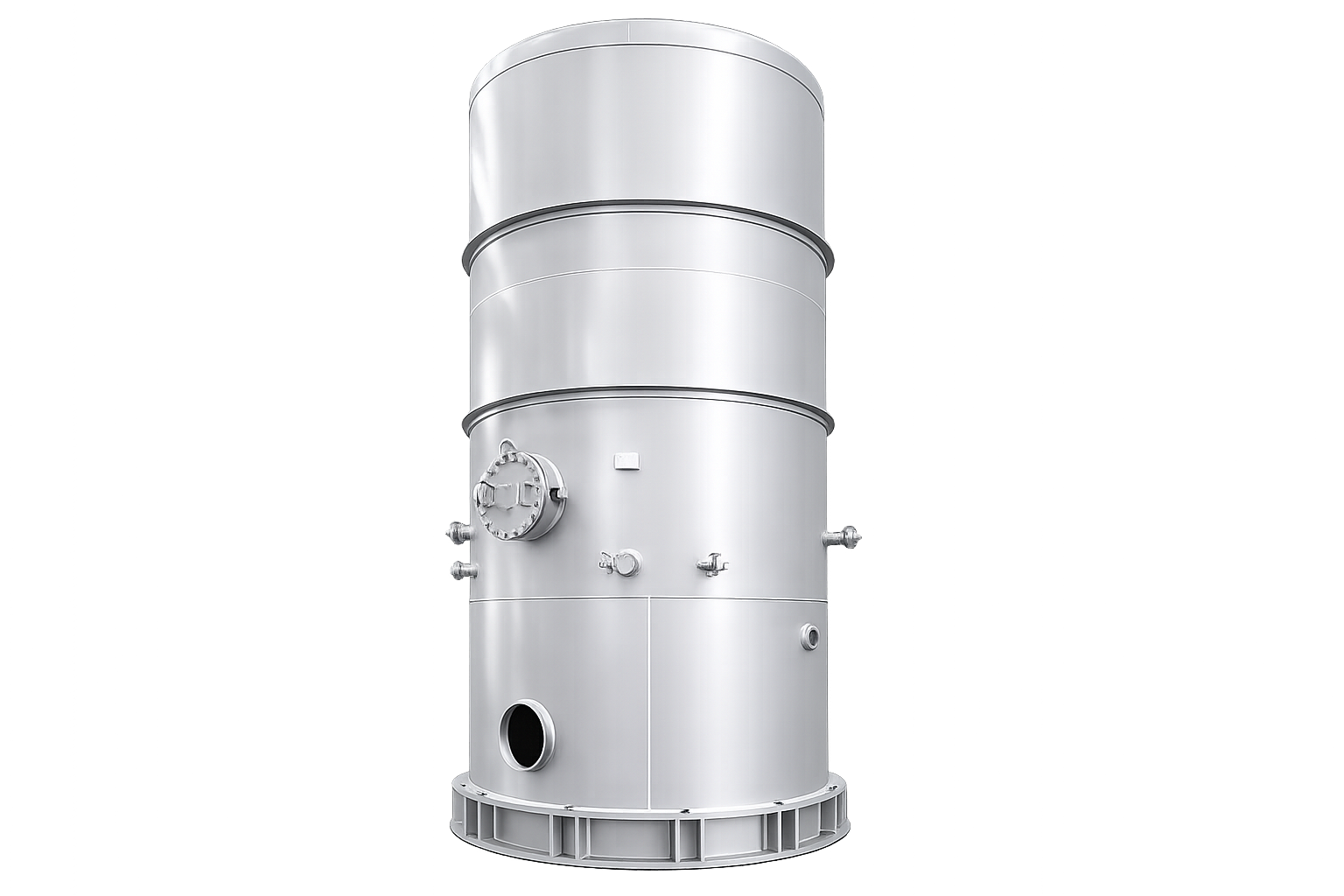
| Part | Function |
|---|---|
| Cylindrical shell | Holds the stored material; plate thickness may step down toward the top |
| Hopper (conical bottom) | Funnels material to the outlet; half-angle chosen for the material's flow properties |
| Flat bottom with discharge nozzle | Used for smaller silos or materials that flow easily; set on legs or a skirt |
| Roof and vent | Weather protection, with a dust filter or vent for air displacement |
| Stiffener rings | Prevent shell buckling under wind, vacuum or unloading loads |
| Support structure | Legs, skirt or frame with anchor bolts to the foundation |
| Inspection hatches and manway | Access for inspection, cleaning and maintenance |
| Discharge outlet and valve | Controls material flow to the next process step |
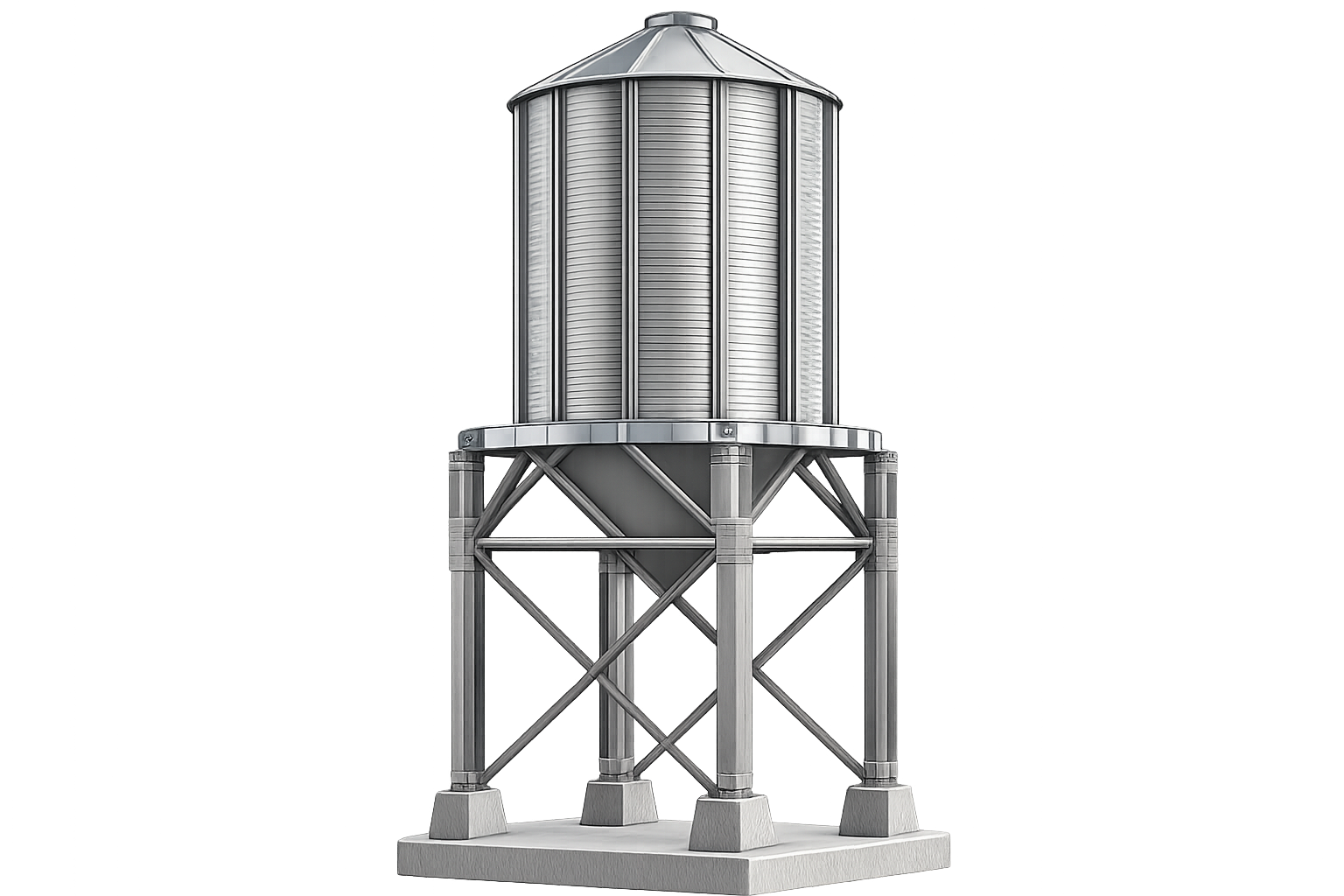
The bottom shape is the most important design choice.
| Feature | Conical bottom | Flat bottom |
|---|---|---|
| Emptying | Good, gravity driven | Needs aids to clear dead zones |
| Height | Taller | Shorter for the same volume |
| Cost | Higher fabrication | Lower fabrication |
| Best for | Cohesive or fine powders, complete emptying | Free-flowing granules, small volumes |
In a mass-flow silo the whole contents move together as the outlet opens, so first in is first out and there are no dead zones. This needs a steep, smooth hopper wall and is preferred for powders that cake, segregate or degrade with time. In a funnel-flow silo a channel forms above the outlet and material moves through the middle while the outside stays stagnant, so the last in can be the first out. Funnel flow is simpler and cheaper but risks rat-holing and time-consolidation of cohesive powders.
The hopper angle, wall roughness and outlet size must be matched to the powder's measured flow properties (typically from a shear-cell test). A good silo designer asks for the bulk density, particle size, moisture content and flow behaviour of the material, because a wrong guess can mean a silo that will not discharge.
A silo carries its own weight, the weight of the stored material and the lateral pressure from the material on the walls, together with wind and earthquake forces on the tall structure. Silo wall pressure behaves differently from liquid pressure: friction against the wall carries part of the load, and pressure peaks occur when the material starts to discharge. Designs therefore allow for fill and discharge pressure cases and for the possibility of vacuum when the material is withdrawn faster than air can enter.
Stiffener rings stop the thin shell from buckling, and anchor bolts and the base ring tie the structure to the foundation against overturning. Creative Engineering designs silos for wind, seismic, stored material and operating loads.
Silos are built in mild steel (MS) or carbon steel (CS) for general dry materials and in SS 304 or SS 316L for food, pharma and chemical powders that need hygiene or corrosion resistance. Surface protection for steel silos uses epoxy paint, polyurethane (PU) paint or hot-dip galvanizing, selected for the environment and expected life. Stainless silos may be internally polished to improve flow and cleanability.
All welds are NDT certified where specified and drawings, material certificates and test reports are provided.
| Problem | What you see | Typical cause and remedy |
|---|---|---|
| Bridging (arching) | Material forms an arch over the outlet and stops flowing | Outlet too small or cohesive powder; enlarge outlet, steepen hopper, add vibrator or air pad |
| Rat-holing | A narrow channel empties while the rest stays packed | Funnel flow with consolidating powder; use mass-flow hopper or flow aids |
| Caking | Material hardens into lumps | Moisture or temperature changes; keep silo dry, use vent filter, consider heating or dry air |
| Segregation | Fines and coarse particles separate | Filling from a single point; use inlet distribution or mass flow |
| Dust emission | Powder escapes at filling | Use a dust filter on the vent and a closed filling line |
| Silo damage | Dents or buckling of shell | Vacuum during fast emptying or uneven discharge; ensure vent capacity and stiffeners |
Solving these problems at the design stage is far cheaper than retrofitting a working silo, so share as much material data as you can at the time of enquiry.
Pneumatic conveying lines, bucket elevators and screw conveyors are the usual ways to fill a silo, and each displaces air that must leave through a vent. An undersized vent can pressurise the silo, while a blocked dust filter can pull a vacuum when the silo is emptied. Level instruments give early warning of overfilling, and access hatches, ladders and platforms must be arranged so that inspection is safe. Entry into a silo is hazardous because of the risk of material engulfment and dust atmosphere, so follow your site's confined-space procedure and never enter an active silo.
Dust from some powders can form an explosive mixture with air. If your material is combustible, discuss explosion relief panels, grounding and bonding, and inerting options with the design team. Creative Engineering supports safe silo design with access platforms, ladders and handrails from its platforms and ladders range.
Silo capacity is usually given in cubic metres or tonnes. Tonnes equal volume multiplied by the bulk density of the material. A cylindrical silo of 3 m diameter and 6 m straight height has a cylinder volume of about 42 cubic metres, and the conical hopper adds more. If the powder has a bulk density of 0.8 tonnes per cubic metre, the cylinder alone holds roughly 34 tonnes.
Remember that bulk density changes with compaction, moisture and aeration, so two quotes based on different densities are not comparable. State the density you used and the fill level that is acceptable. Also state the required live capacity at the discharge point, because the cone volume and unusable dead zones affect how much material can be withdrawn.
| Diameter (m) | Straight height (m) | Cylinder volume (m³) | Capacity at 0.8 t/m³ (tonnes) |
|---|---|---|---|
| 2.0 | 4.0 | 12.6 | 10.1 |
| 2.5 | 5.0 | 24.5 | 19.6 |
| 3.0 | 6.0 | 42.4 | 33.9 |
| 4.0 | 8.0 | 100.5 | 80.4 |
Figures show the cylindrical part only and are for illustration; the hopper volume and fill margin are added in the actual design.
Contact us through the contact page. We serve Bharuch, Vadodara and Ahmedabad and export to many countries.
A silo stores dry bulk materials such as powders, granules and pellets in chemical, food, pharma, fertilizer and cement plants.
A storage tank holds liquids, while a silo holds dry bulk solids. Silo design must handle powder flow behaviour, such as bridging and rat-holing, and the unusual pressures that solids exert on the walls.
A conical hopper bottom is best for cohesive or fine powders because it promotes complete emptying; a flat bottom suits free-flowing granules and small volumes.
Mass flow means the entire contents move together as the outlet opens, giving first-in-first-out discharge and no dead zones.
Mild steel and carbon steel with paint or galvanizing for general materials, and SS 304 or SS 316L for food, pharma and corrosive powders.
Use a hopper with the correct angle and smooth walls, and add discharge aids such as vibrators, air pads or fluidization pads.
Creative Engineering of Ankleshwar manufactures silos in MS, CS, SS 304 and SS 316L for chemical, pharma and industrial plants.
Creative Engineering, Ankleshwar, Gujarat designs and manufactures process equipment to ASME and IBR codes. Share your drawing or process data and our team will respond with a technical offer.








 Reactor
 High Pressure Vessel
 Skid Equipment
 Receiver
 Heat Exchanger
 Pressure Vessel
 Silo
 Solvent Stripper
 Pharma Equipments