A guide to square and rectangular tanks: flat-bottom and sloped-bottom designs, multi-compartment tanks, GMP and food-grade finish, external stiffeners, materials, and how to order a square tank built to exact dimensions.

A square tank is a fabricated tank with a square or rectangular footprint instead of a round one, built in stainless steel or carbon steel to the exact dimensions the plant needs. It is used for batch holding, process liquids, cooling or washing, and GMP or food-grade service, and is stiffened on the outside because flat walls cannot carry load like a cylinder.
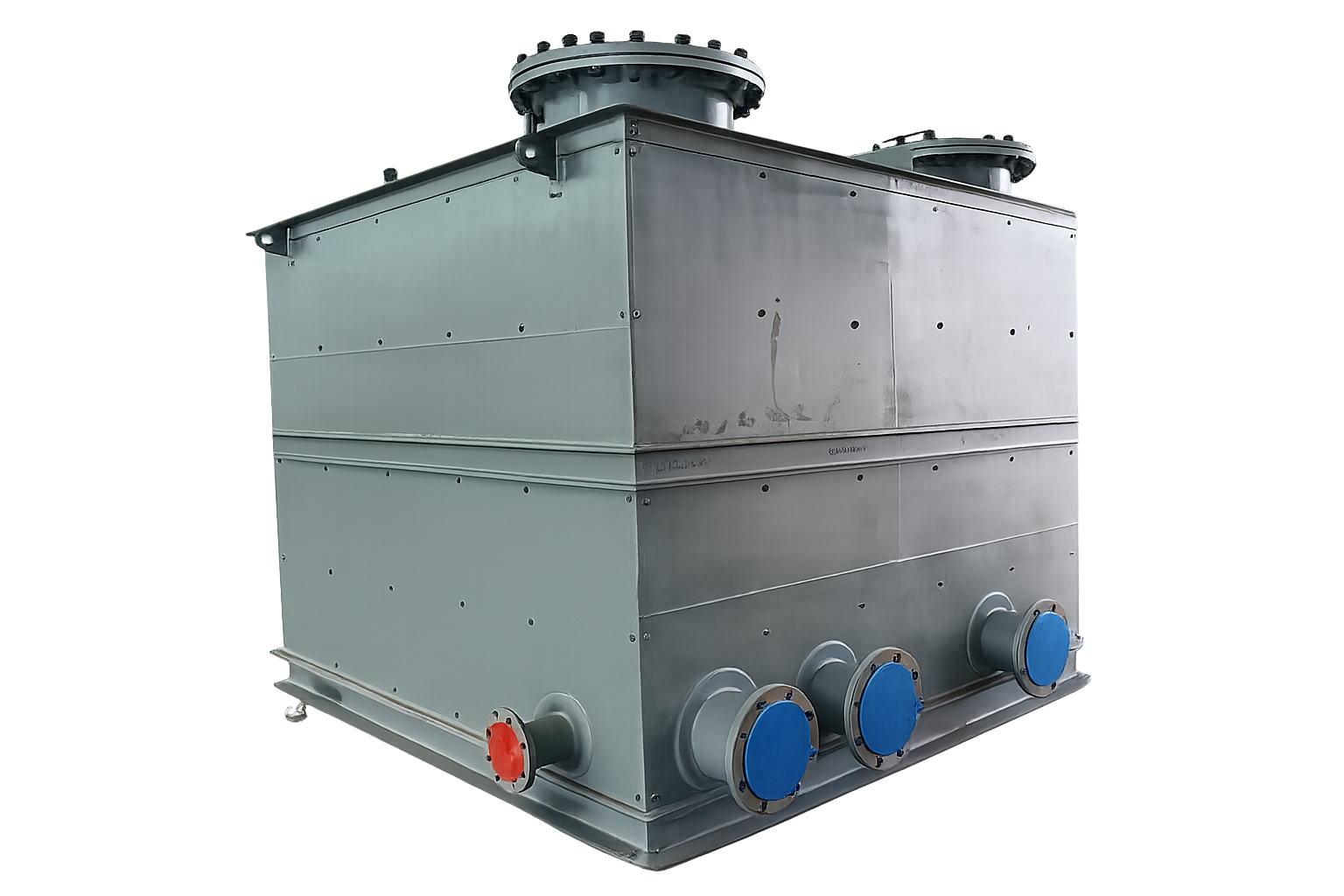
A square tank is an open-top or closed tank with flat vertical walls and a square or rectangular plan. Where a round storage tank is the efficient shape for bulk storage under load, a square tank trades some structural efficiency for practical advantages: it fits into rectangular plant layouts, can sit against walls and between machines, and is easy to partition into compartments, to fit with covers and to equip with side-mounted instruments or heating coils.
In process industries, square tanks serve as batch holding tanks, dosing and mixing tanks, wash and rinse tanks, cooling and quenching tanks, and in the food and pharma sector as hygienic holding tanks. Because they are made to order, the dimensions are decided by the space and the process rather than by a standard catalogue.
Creative Engineering fabricates square and rectangular tanks in Ankleshwar in stainless steel (SS 304, SS 316L) and carbon steel, in sizes built to the customer's exact dimensions.
| Type | Description | Typical use |
|---|---|---|
| Flat-bottom square tank | Standard design with a level floor, SS 304 or SS 316L | General holding and process tanks |
| Rectangular tank | Longer than wide, fits narrow layouts | Batch holding, wash tanks, multi-compartment systems |
| Sloped-bottom tank | Floor slopes toward a drain | Full drainage and easy cleaning |
| GMP / food-grade tank | Electro-polished interior with crevice-free welds, surface roughness Ra of 0.4 µm or better | Pharma, food, beverage, hygienic liquids |
| Partitioned / multi-chamber tank | Internal walls form separate compartments | Multi-stage washing, settling, sequential processes |
A hygienic tank's finish is as important as its shape. Electro-polishing removes microscopic peaks from the metal surface, which reduces product adhesion and improves cleaning.
A cylinder resists liquid pressure by hoop tension, with the wall in simple stretching. A flat wall instead has to resist the pressure by bending, like a loaded plank, which needs much thicker plate for the same height. To avoid very thick walls, flat-sided tanks are reinforced with external stiffeners: horizontal bands, angles or channels welded around the outside, or vertical ribs, which cut the unsupported span of the plate and keep it from bulging.
The pressure at the bottom of a tank is highest, so stiffeners are closer together near the floor and wider apart near the top. Tank height, liquid density and the presence of a cover or top frame all enter the calculation. Where the tank is large, internal tie rods or beams add extra support. Designing stiffeners properly is what makes a square tank both safe and economical, and it is the reason an experienced fabricator should calculate each tank rather than copy a drawing.
Flat-bottom square tanks are standard in SS 304 or SS 316L. Where more resistance is needed, the same range of materials as our other equipment is available: SS 304L, 316, 316Ti, 321, Duplex, Super Duplex, Inconel, Hastelloy, CuNi, 904L and carbon steel grades such as SA 516 and IS 2062. Carbon-steel tanks are shot-blasted and painted, or lined with rubber or FRP where required. For GMP service the interior is electro-polished and pickled and passivated to restore the protective oxide layer on stainless steel.
Capacity is simple geometry: volume = length × width × liquid height. If the dimensions are in metres, the answer is in cubic metres, and one cubic metre equals one kilolitre (1,000 litres). For example, a tank 2 m long, 1.5 m wide and 1.2 m high holds 3.6 cubic metres, or 3,600 litres, when completely full. Because tanks are not filled to the brim, the working volume is typically 85 to 95 percent of the total, depending on freeboard, splash and the presence of a cover.
The pressure at the bottom of the tank rises with liquid height and density: it equals density times gravity times height. A column of water 1.2 m high produces about 11.8 kPa at the floor, which is why even a modest tank needs stiffeners. If the fluid is twice as dense as water, the bottom pressure doubles.
| Length (m) | Width (m) | Height (m) | Total volume (litres) |
|---|---|---|---|
| 1.0 | 1.0 | 1.0 | 1,000 |
| 2.0 | 1.5 | 1.2 | 3,600 |
| 3.0 | 2.0 | 1.5 | 9,000 |
| 4.0 | 2.5 | 2.0 | 20,000 |
These figures are geometric volumes. Your quotation should state the working volume you need so the height can be set accordingly.
With simple care, a stainless steel square tank gives decades of service. We also support customers after delivery with preventive maintenance programs and a technical helpdesk.
Square tanks used at atmospheric pressure are not pressure vessels, so they are designed by plate-bending and stiffener calculation rather than by a pressure vessel code, but a competent fabricator still documents the design, material and tests. Creative Engineering supplies drawings, material test certificates and weld and test records, and the work is carried out under an ISO 9001:2015 quality system with certified welders. If a covered tank must withstand pressure or vacuum, tell us at enquiry stage, because it will need a different design basis and may need to be built as a pressure vessel instead. Personnel safety features such as handrails, ladders and platforms can be added from our platforms and ladders range.
| Factor | Square / rectangular tank | Round (cylindrical) tank |
|---|---|---|
| Floor space use | Excellent, fits rectangular rooms and skids | Leaves unused corners |
| Structural efficiency | Needs stiffeners, more steel per litre | Most efficient, thin walls |
| Compartments | Easy to partition | Harder to partition |
| Pressure capability | Open or low head only | Atmospheric to pressure |
| Cleaning | Corners need smooth radii or sloped bottom | Easier, no corners |
| Cost per litre | Higher for large volumes | Lower for large volumes |
For large volumes and anything pressurised, a round tank or pressure vessel is the better choice. For small to medium volumes that must fit a specific footprint, a well-stiffened square tank is often the practical answer.
For round bulk storage see our storage tank page, and for dry bulk see the silo guide.
Our manufacturing capability includes CNC machining, electro-polishing, buffing and a dedicated stainless steel unit, plus certified welders and NDT Level II inspection.
Send these through our customize equipment page or the contact page. We respond within 24 hours.
Square tanks are used for batch holding, dosing, washing, cooling and process liquids in pharma, food, chemical and metal-finishing plants, wherever a rectangular shape fits the space.
Flat walls resist liquid pressure by bending, so stiffeners shorten the unsupported span and prevent bulging, allowing thinner plate.
Yes. SS 316L is a common material, especially for GMP, pharma and food-grade tanks, with electro-polished interiors.
A square tank has equal length and width, while a rectangular tank is longer in one direction. Both are made to the customer's dimensions.
Yes. Partitioned multi-chamber tanks have internal walls that form separate sections for sequential washing, settling or holding.
Ra is a measure of surface roughness. A value of 0.4 micrometres or better is a very smooth, hygienic finish achieved by mechanical polishing and electro-polishing.
Creative Engineering of Ankleshwar manufactures square and rectangular tanks in stainless steel and carbon steel to exact customer dimensions.
Creative Engineering, Ankleshwar, Gujarat designs and manufactures process equipment to ASME and IBR codes. Share your drawing or process data and our team will respond with a technical offer.






 Reactor
 High Pressure Vessel
 Skid Equipment
 Receiver
 Heat Exchanger
 Pressure Vessel
 Silo
 Solvent Stripper
 Pharma Equipments