A complete guide to industrial chemical reactors: how a reactor works, jacket and agitator options, materials of construction, ASME and IBR codes, and how to choose a reactor manufacturer in Gujarat, India.

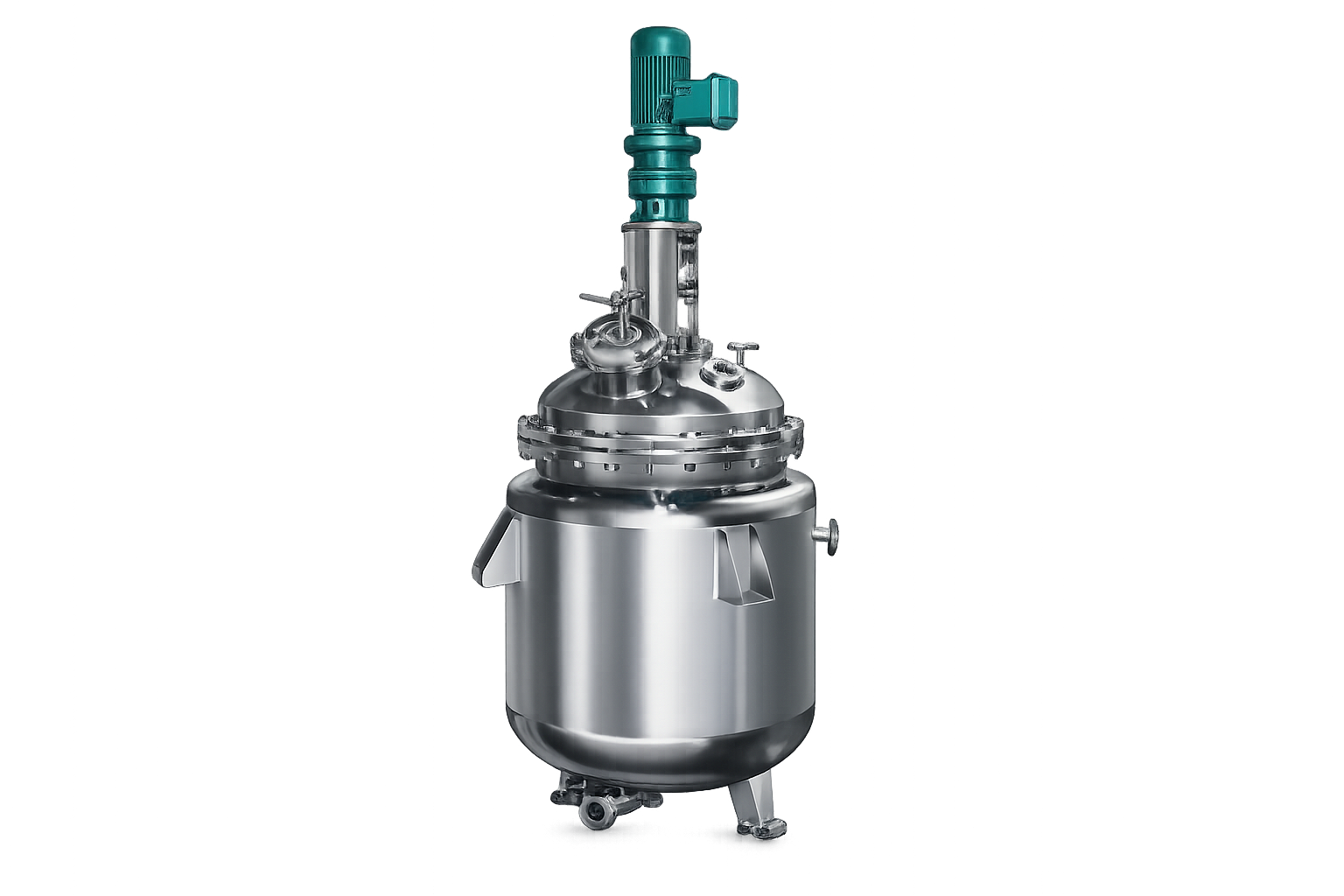
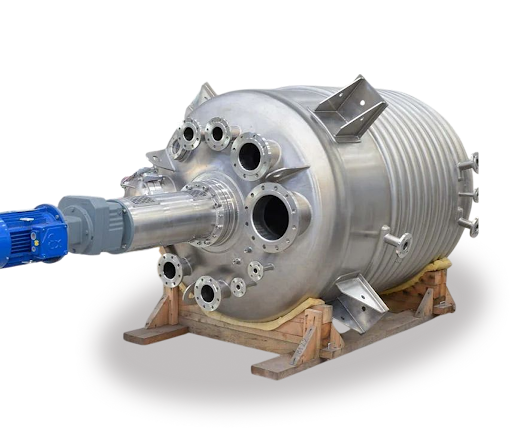
A reactor is a closed process vessel in which a chemical reaction is carried out under controlled temperature, pressure and mixing. Industrial reactors are usually jacketed (or fitted with limpet or internal coils) for heating and cooling, carry an agitator to keep the reaction mass uniform, and are built in stainless steel, carbon steel or exotic alloys to ASME Section VIII Div 1 and IBR where applicable.
In chemical engineering, a reactor (also called a chemical reactor or reaction vessel) is the piece of process equipment in which raw materials are converted into products. It is the heart of almost every chemical, pharmaceutical, agrochemical and petrochemical plant. Everything else on the plant, from feed tanks and pumps to filters, dryers and distillation columns, exists either to prepare material for the reactor or to recover and purify what comes out of it.
A reactor must do four jobs at the same time: contain the reaction safely, control temperature by adding or removing heat, mix the contents so the reaction is uniform, and resist corrosion from the chemicals inside. How well these four jobs are balanced decides the yield, the product quality and the safety of the process.
The terms reactor, reaction vessel and reaction kettle are used almost interchangeably in industry. At Creative Engineering we manufacture both a standard jacketed reactor range and engineered reaction vessels for batch chemistry, and the two pages share most design principles described below.
A typical batch reactor works in a repeating cycle. Raw materials and solvent are charged through a manhole or charging nozzle. The agitator starts and the jacket circulates steam, hot water, thermic fluid or chilled water to bring the mass to reaction temperature. Reagents are dosed in at a controlled rate, because many reactions release heat and must not run away. When the reaction is complete the batch is cooled, discharged through a bottom valve, and the vessel is cleaned for the next batch.
Continuous reactors such as tubular and CSTR (continuous stirred tank) designs run the same chemistry with steady feed and product streams, but in the specialty chemical, API and agrochemical industries the stirred batch reactor remains by far the most common because one vessel can make many different products.

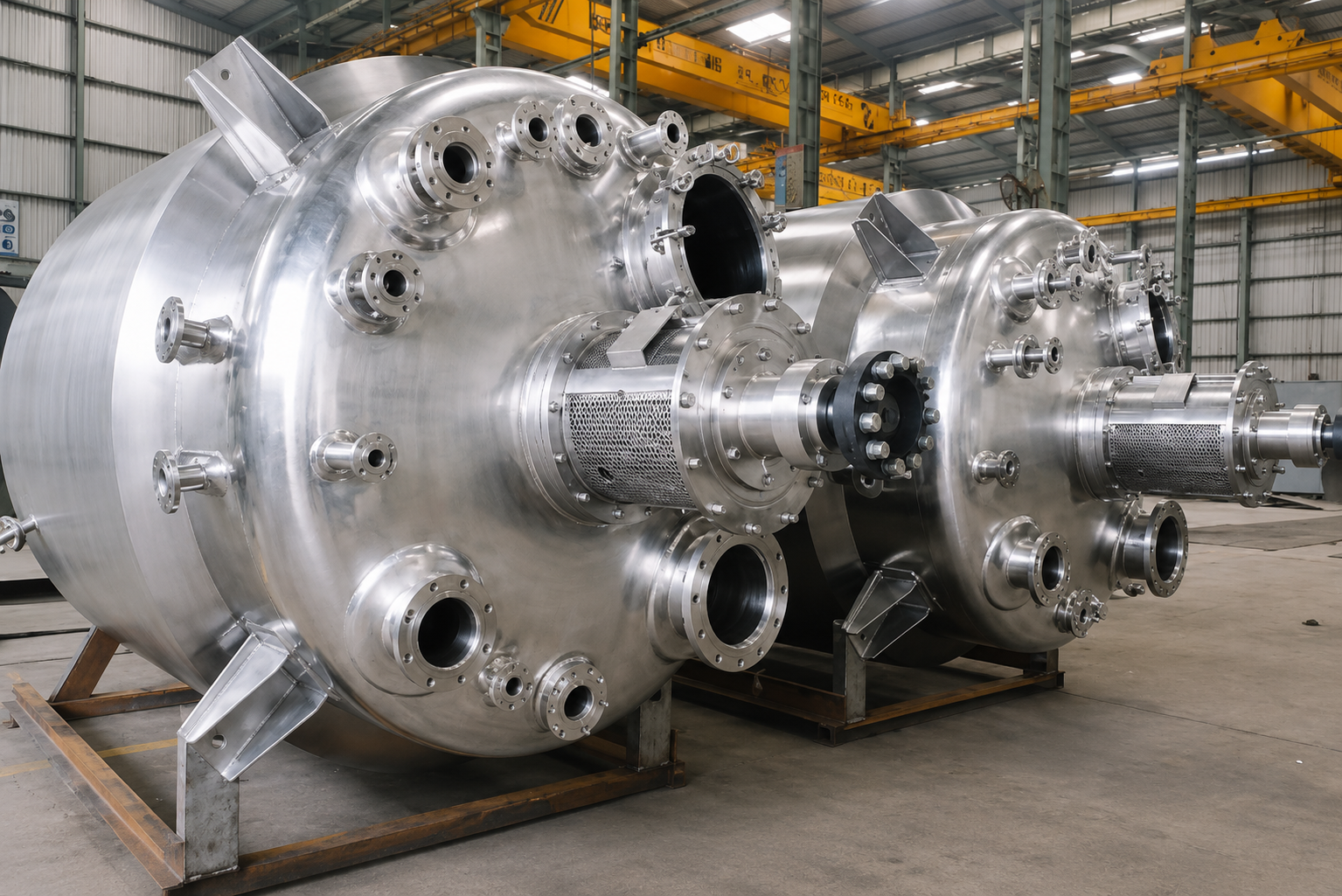
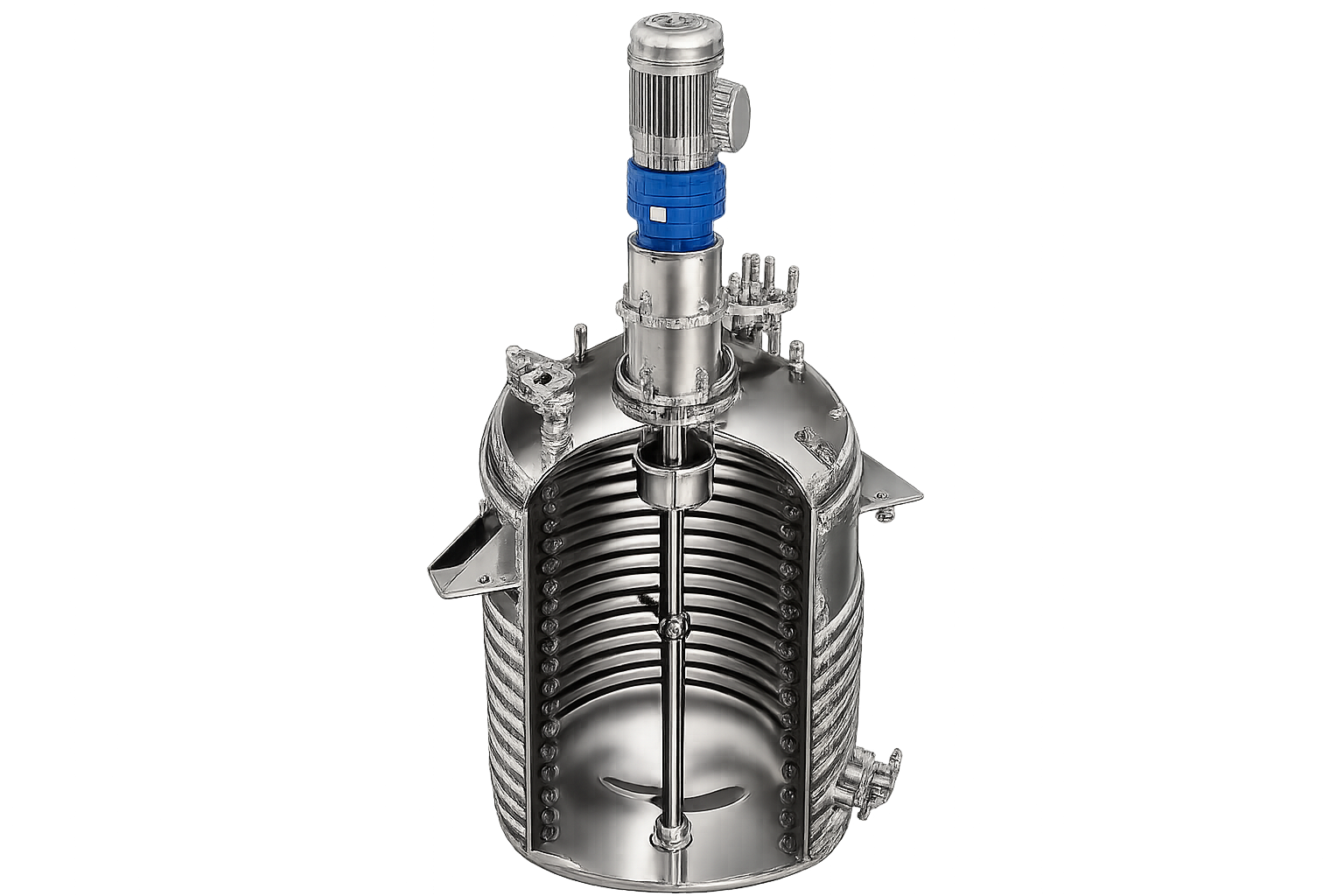
| Part | Function |
|---|---|
| Shell and heads | The pressure-containing body. Heads are usually 2:1 ellipsoidal or torispherical and the shell thickness is calculated to ASME Section VIII Div 1. |
| Jacket, limpet coil or internal coil | Heat transfer surface for heating and cooling the batch. |
| Agitator and gearbox | Mixes the contents; driven by a motor and gearbox mounted on the top (or bottom or side) of the vessel. |
| Mechanical seal | Seals the rotating agitator shaft where it passes through the vessel, so gas and vapour do not leak. |
| Baffles | Fixed plates or tubes that break up vortex formation and improve mixing. |
| Nozzles and manholes | Charging, discharge, instruments, safety valve, condenser and vent connections. |
| Support legs, lugs or skirt | Carry the weight of the vessel and its contents. |
| Instruments | Temperature probe, pressure gauge, level switch, rupture disc and safety relief valve. |
Each of these items is specified on the General Arrangement drawing and checked in the design calculation before fabrication begins.
The way heat is carried into or out of the batch is the most important choice in reactor design. Creative Engineering fabricates the following configurations.
A full outer jacket surrounds the cylindrical shell (and sometimes the bottom head). Steam, hot water, chilled water or thermic fluid flows through the annular space. Jacketed reactors are the general-purpose standard for chemical and pharma batch processing and give a large, uniform heat transfer area.
External half-pipe coils are welded to the outside of the shell. Because the coil is a small-diameter channel, it can carry much higher pressure than a wide jacket, and the fluid velocity (and therefore the heat transfer coefficient) is higher. Limpet coils are preferred where the utility pressure is high, for example high-pressure steam or thermic fluid.
A helical or serpentine coil is installed inside the vessel. It adds heat transfer area for strongly exothermic reactions or very cold duties, at the cost of a harder-to-clean interior, so it is used mainly where cleaning is not a concern.
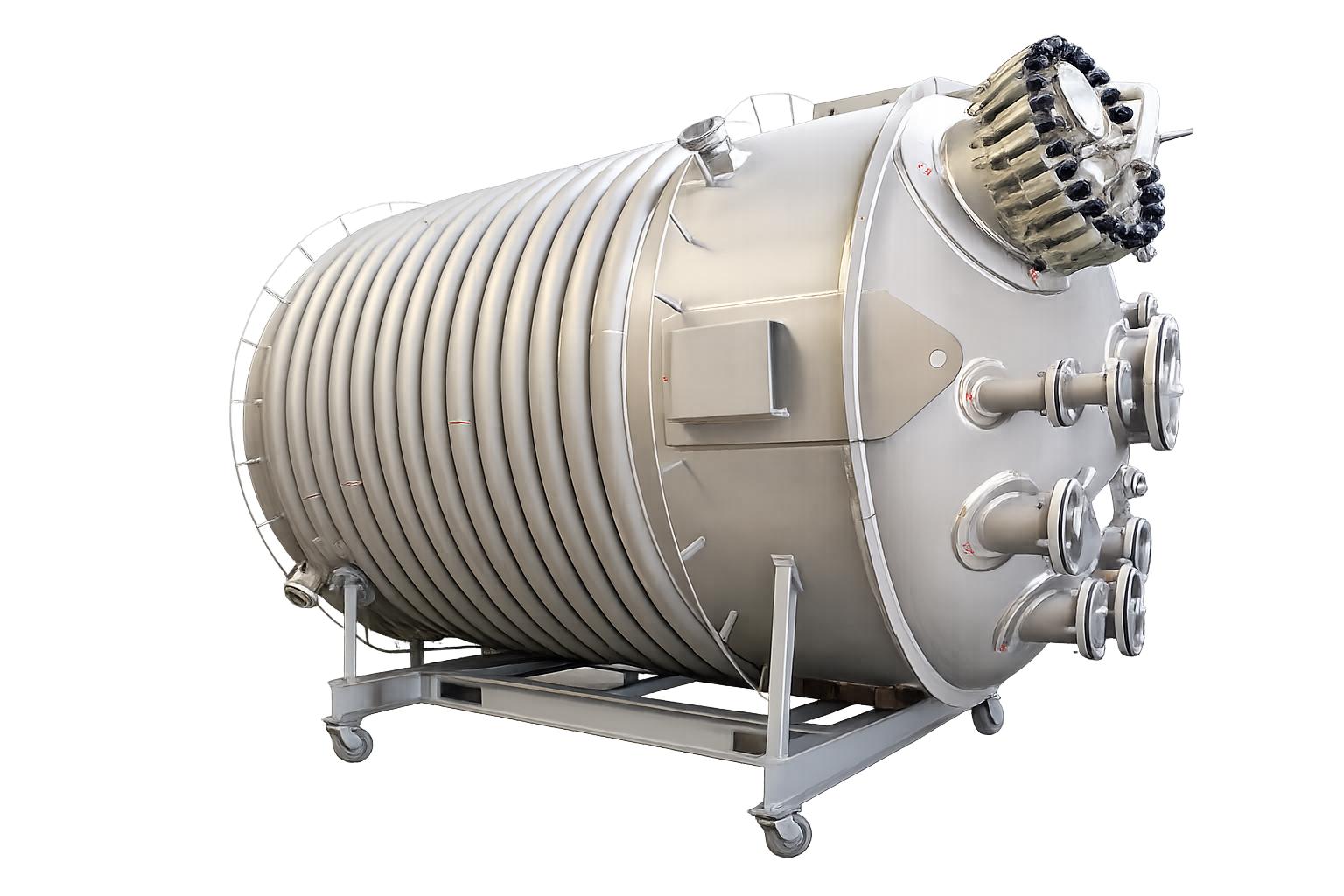
Heavy-wall reactors designed for elevated pressure, fitted with robust mechanical seals and full ASME documentation. See our related guide on the high-pressure vessel for the design basis.
A reactor with a gas-induction agitator that draws gas from the headspace and disperses it in the liquid. It is used for hydrogenation and other gas-liquid reactions.
High-shear agitators, reinforced baffles and high-RPM drives are used for emulsification, dispersion and fast-mixing duties.
For pharmaceutical and API intermediates the interior is electro-polished and crevice-free, so product does not hide in welds or joints and the vessel can be cleaned and validated.
| Type | Best for | Key advantage |
|---|---|---|
| Jacketed | General batch chemistry | Large uniform heat transfer area |
| Limpet coil | High-pressure steam or thermic fluid | High utility pressure and velocity |
| Internal coil | Strong exotherms | Extra heat transfer area |
| High-pressure | Hydrogenation, elevated pressure | Heavy wall, ASME documentation |
| GMP | API and pharma intermediates | Electro-polished, crevice-free |
| Cladded / explo-bonded | Highly corrosive service | Alloy skin on a carbon steel body |
The agitator decides how fast heat and reactants spread through the batch. Choosing the wrong impeller is one of the most common causes of poor reactor performance, so selection is driven by viscosity and by what the process needs the impeller to do: blend liquids, suspend solids, disperse gas or break up droplets.
| Agitator | Typical use |
|---|---|
| Anchor and anchor impeller | High-viscosity fluids; sweeps the wall to improve heat transfer |
| Turbine and paddle | General blending and dispersion |
| Helical (ribbon) | Viscous and shear-sensitive materials |
| Maxblend | Wide viscosity range, good mixing with low power |
| Propeller, pitched blade and hydrofoil | Axial flow for blending and solids suspension |
| Retreat curve | Medium-viscosity mixing with low shear |
Agitators can enter from the top, bottom or side, and shafts are sealed by a mechanical seal. Larger vessels often use multi-stage impellers on the same shaft. Our shop includes agitator fabrication, homogeniser manufacture and dynamic balancing so that the rotating assembly runs smoothly.
The wetted material has to survive the reaction chemistry for years. Creative Engineering fabricates reactors in a very wide range of materials of construction (MOC):
Surface finish matters as much as the metal. Options include blasting, painting, mirror polish, matte finish and electro-polishing. Mirror and electro-polished finishes reduce product build-up and are standard on pharma reactors.
A reactor holds hot, pressurised, often hazardous material, so its design and fabrication follow recognised codes:
Before dispatch each reactor goes through non-destructive testing (radiography, ultrasonic, dye-penetrant and magnetic-particle as specified) and a hydrostatic or leak test. Customers receive a documentation dossier: general arrangement drawings, design calculations, material test certificates (MTC), NDT reports and the hydro-test certificate.
Reactors are used wherever chemistry is done at scale. The main sectors that Creative Engineering supplies are:
Before requesting a quotation, collect the following process data. It will let any serious fabricator return an accurate offer without repeated clarifications:
Then evaluate the manufacturer on certifications (ASME U and R stamps, IBR, ISO 9001:2015, ISO 3834 for welding quality), in-house capability (CNC machining, agitator shop, polishing, NDT Level II staff) and references from similar industries. See our certification page and manufacturing capability for details.
Gujarat is one of India's largest chemical-manufacturing states, and the Ankleshwar-Bharuch-Dahej belt holds one of the densest clusters of chemical and pharma plants in the country. Creative Engineering is a reactor manufacturer in Ankleshwar, Gujarat, established in 2015, with two manufacturing units covering about 1,75,000 sq ft, 650+ projects delivered and a 24-hour response on enquiries. We serve Bharuch, Vadodara, Ahmedabad, Surat, Mumbai and Dahej, and supply export customers across the Middle East, Africa, Asia, Europe and the Americas.
Our reactors are built to ASME Section VIII Div 1 and IBR, in SS 304, 316L and a long list of exotic alloys, with jackets, limpet coils, internal coils and agitator systems engineered to your process. Typical customers range from API manufacturers to large petrochemical groups.
A reactor is a closed vessel in which a chemical reaction takes place under controlled temperature, pressure and mixing. Batch, semi-batch and continuous designs are common, and the stirred jacketed batch reactor is the most widely used in specialty chemical and pharma plants.
In practice the terms are used interchangeably. Both mean an agitated, usually jacketed vessel for carrying out a reaction. "Reactor" is the more common term for the whole system including agitator and drive, while "reaction vessel" often refers to the pressure-containing vessel itself.
A jacketed reactor has a full outer shell around the vessel through which the heating or cooling fluid flows. A limpet coil reactor has half-pipe channels welded to the outside. Limpet coils handle higher utility pressure and give higher fluid velocity, while jackets give a larger, simpler heat transfer area.
There is no single best material. SS 304 suits mild duties, SS 316L is the standard for chlorides and pharma, and Duplex, Hastelloy, Inconel or lined/cladded vessels are used for aggressive acids and high temperatures. The choice depends on the chemistry, temperature and cleaning regime.
Pressure-containing reactors are designed to ASME Section VIII Division 1 (with welding to ASME Section IX). Where steam or boiler-related duty applies, IBR approval is required, and pharma reactors follow GMP design practice.
Anchor, anchor-impeller and helical (ribbon) agitators are used for high-viscosity fluids because they sweep the vessel wall and move the bulk material. Turbines and paddles are better for low to medium viscosity blending.
Creative Engineering, based in Ankleshwar, is an ASME U and R stamp holder, IBR approved and ISO 9001:2015 certified manufacturer of reactors, with more than 650 projects delivered. You can request a quotation at creative-engineering.in/contact-us/.
Yes. Creative Engineering supplies international customers and supports export documentation and procurement. Export markets include the Middle East, Africa, Asia, Europe, the USA and Australia.
Creative Engineering, Ankleshwar, Gujarat designs and manufactures process equipment to ASME and IBR codes. Share your drawing or process data and our team will respond with a technical offer.


 Reactor
 High Pressure Vessel
 Skid Equipment
 Receiver
 Heat Exchanger
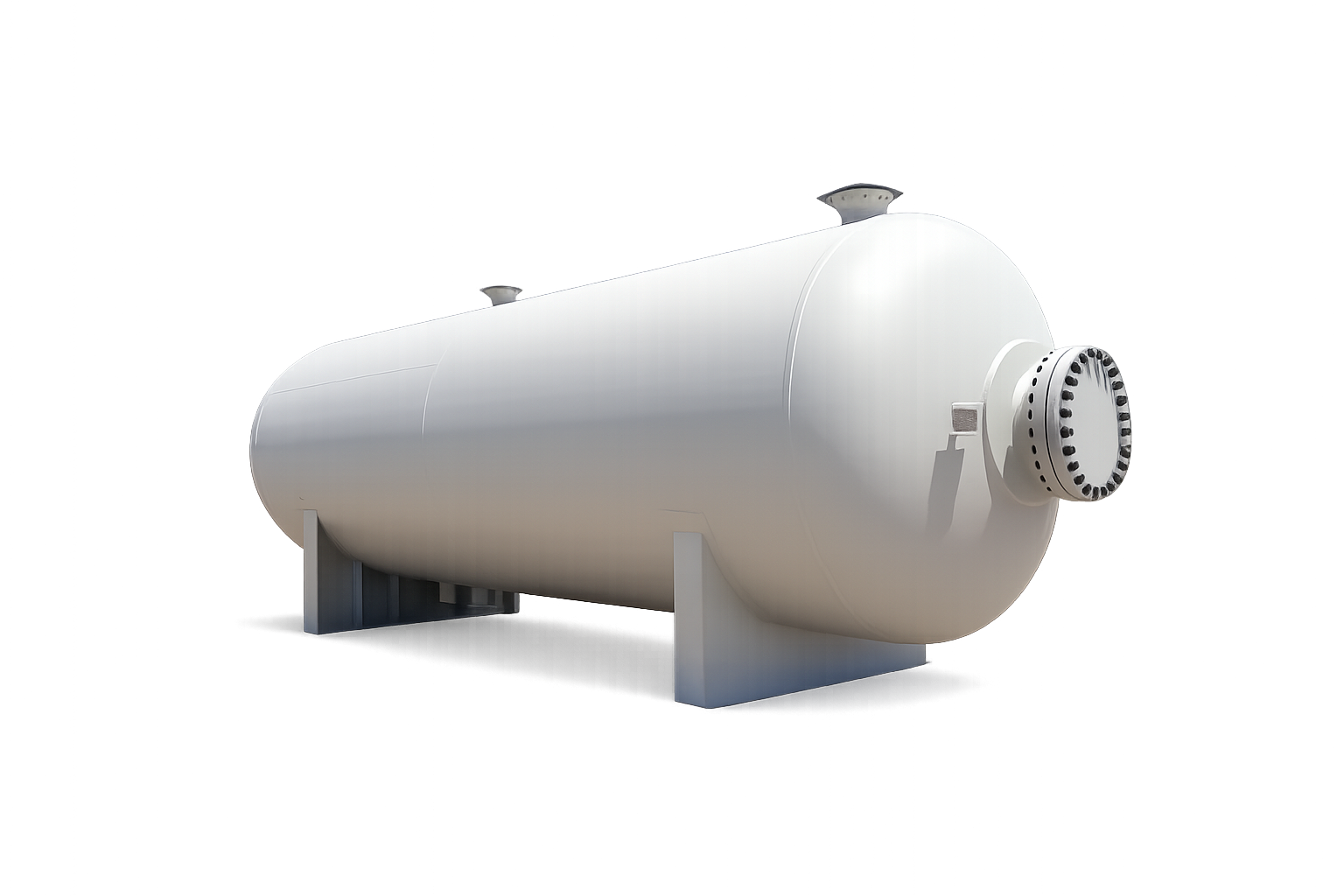 Pressure Vessel
 Silo
 Solvent Stripper
 Pharma Equipments